
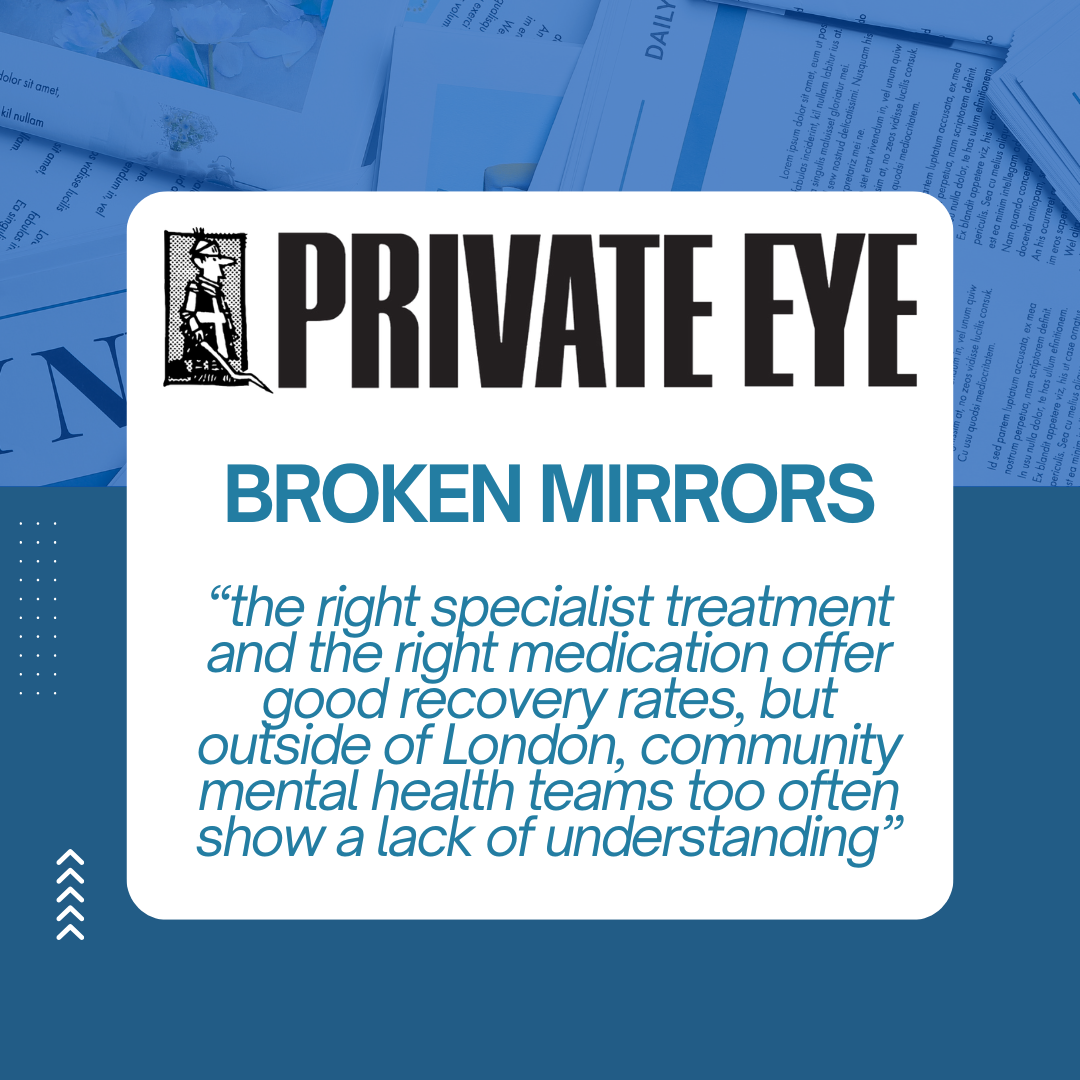
We’re grateful to Private Eye for highlighting Body Dysmorphic Disorder (BDD) in its latest issue, helping to raise awareness of a condition that remains widely misunderstood despite affecting around 1 in 50 people.
The article tells the story of a young man living with severe BDD and his family’s long struggle to access appropriate diagnosis and treatment. It highlights the devastating impact BDD can have when it goes unrecognised and the challenges many people continue to face in accessing specialist care.
The story reflects the reality for many in our community, trying to access specialist treatment via the NHS. The article also references the work of Professor David Veale, Patron of The BDD Foundation and one of the world’s leading experts in Body Dysmorphic Disorder. Professor Veale, who contributed to the World Health Organization’s diagnostic criteria for BDD, highlights the importance of accurate diagnosis and access to specialist treatment, particularly for individuals with severe and complex presentations.
The Foundation’s Managing Director, Kitty Newman, also contributed to the article, emphasising that BDD is too often dismissed or misunderstood despite being associated with significant distress and one of the highest suicide risks of any mental health condition.
“The condition is too often treated as flippant when it can be incredibly serious with a very high risk of suicide. Early treatment with the right specialist care and the right medication offers good recovery rates, but outside of London, community mental health teams too often show a lack of understanding and are failing to follow the government guidelines. As we are seeing with Alex and people up and down the country, this has a devastating impact.”
At The BDD Foundation, we continue to advocate for earlier recognition of BDD, greater understanding amongst healthcare professionals, and equitable access to evidence-based treatment.
We would like to thank Private Eye for helping to bring national attention to this important issue. Every conversation that improves understanding of BDD helps us move closer to a future where nobody affected by the condition suffers alone.