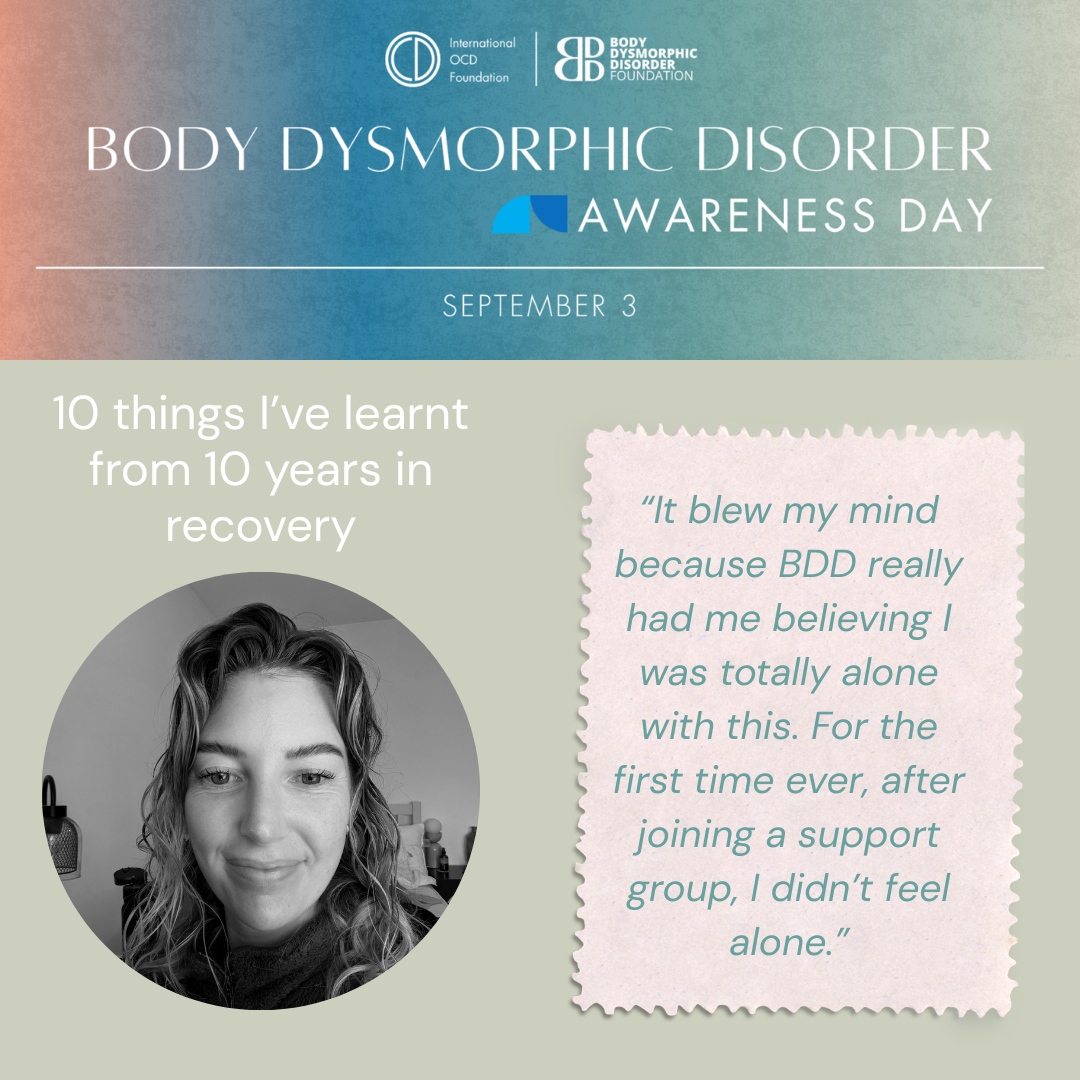
As part of BDD Awareness Day, our Project Manager Gem shares her learnings from 10 years in recovery
1. Community keeps me on the straight and narrow. Isolation and shame are almost a guaranteed experience if you have BDD. Still to this day one of my biggest turning points in recovery (alongside treatment) was connecting with other people who also live with BDD. It blew my mind because BDD really had me believing I was totally alone with this. For the first time, after joining a support group, I didn’t feel alone. My peer support comes in slightly different forms now, but I know for absolute certain that this is a channel of support I will continue to need throughout my recovery.
2. I’ve experienced the distorted perception enough times now to accept, and have a deep sense of knowing, that this must be at play when I’m having a lapse. It just can’t be possible that my appearance can physically change as much as my perception tells me so, especially not in the short time frames it seems to. I have to trust that my view of myself is emotionally charged and this impacts my perception. It’s very hard to accept. But I try and trust this is likely the case when I’m feeling so distressed by my appearance. As part of this, uncertainty is something I’m learning to live with. I still have lots of moments where I don’t know what I really look like, or whether I can trust what I see. Learning to sit with that uncertainty, rather than urgently trying to resolve it, has been a huge (and ongoing) part of recovery.
3. It’s harder to talk about BDD when I’m ‘in it’. By this I mean a lapse or relapse… anytime BDD has become very loud again. But the people who love and care about me still do when I share that I’m not doing so great. They actually want to be aware and are often glad I can trust them enough to tell them. It gives them the chance to offer kindness and support when I need it most. BDD is so quick to convince me I’m a burden and should avoid and keep things to myself, but it’s really important to share. As soon as I’m authentic about this, the shame quietens.
4. We still have a long way to go for true understanding. I’m lucky to be in a ‘BDD bubble’ sometimes. Not a line I ever thought I’d say, but in the sense that I’m surrounded by people who understand it and/or care about treating it. These people truly understand the severity of BDD. But when I share about my role with people outside of my work, there is almost always a misconception shared in the first 5 minutes of that conversation. Of course, this is a good opportunity to educate but it hits me every time how far we still have to go.
5. Working in the charity sector is such a tough gig right now. Securing funding is a constant challenge. The pots are smaller, criteria are stricter, and expectations around outcomes are higher than ever. It’s disheartening at times, but the lesson for me here is that the need for our work makes persistence non-negotiable. What keeps me going is remembering that every small nudge in the right direction can make a huge difference in someone’s life, and we are lucky to see this play out for service users on a regular basis as such a small team.
6. The regret from my surgeries is something that requires continual healing. 10 years on I guess I thought it wouldn’t harm me so much anymore, but it’s such a traumatic experience that it feels hard to ever fully get away from. I carry a sadness that the hope I once had for my distress to diminish from a physical solution will never truly be available to me again. There’s a kind of grief in that. Not just for what happened, but for what I believed might ‘save’ me. I try to remind myself that I made those decisions from a place of pain. At the time, I was doing the best I could with what I thought might help me. That doesn’t take the regret away, but it helps me hold it a little more gently. Self forgiveness and acceptance for my past decisions is the path I now try to follow. This is an ongoing practice.
7. Every single person I’ve ever met with BDD is beautiful inside and out. Truly. And I know reassurance around appearance is unhelpful in the context of BDD, but I mean beautiful souls with such heartfelt intentions and compassion for others. It continues to baffle me that these people can be so cruel to themselves. It really feels like a curse sometimes. But this realisation is also helpful evidence for me, a mirror I guess, that I am likely doing the exact same to myself when I’m not doing so well. It’s almost impossible to have an objective view of yourself when BDD is in the driving seat.
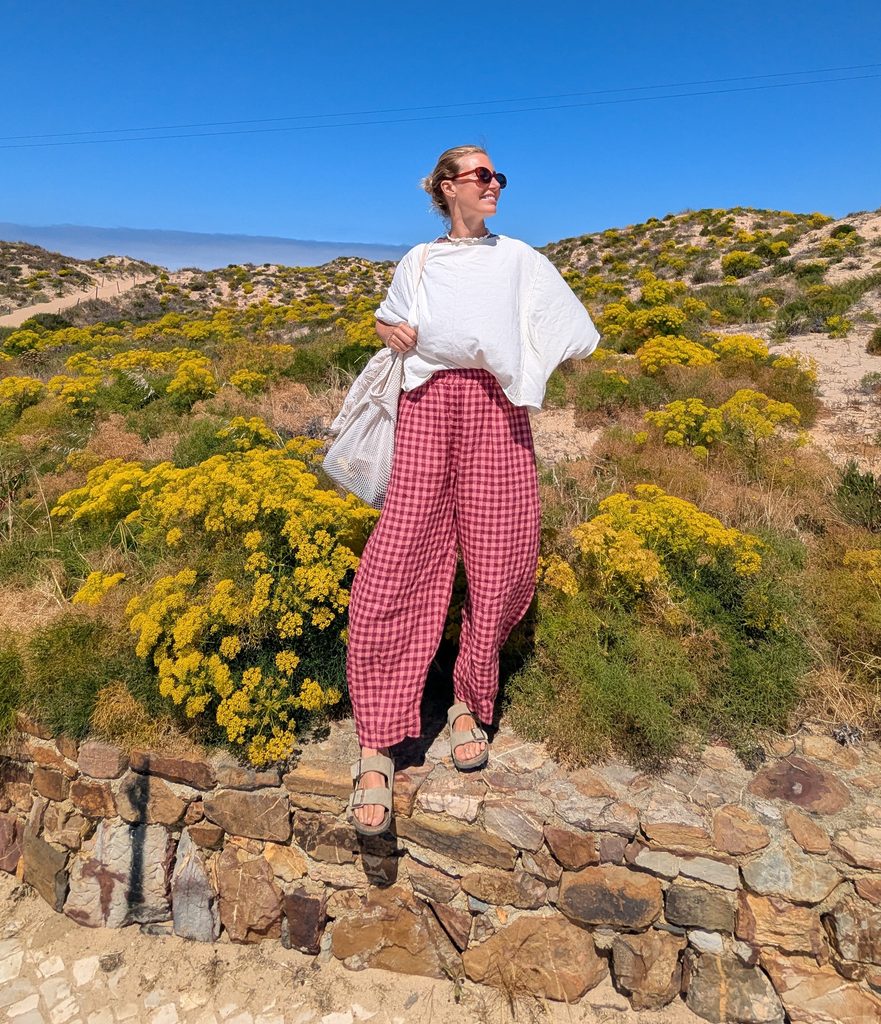
8. It is possible to experience joy again. For a long time I thought recovery was just a case of masking through life and being able to accept how hideous I am. This is another of BDD’s lies. My life is now full of beautiful joys, things I love doing, hobbies, people, relationships, creativity, awe, movement, purpose… That I never thought were possible. I remember the first time in my recovery that I sat through a whole theatre show without having one BDD thought. I felt so proud, and so hopeful for the possibility that I might not forever be plagued by the relentless onslaught of critical BDD thoughts. This is possible with the right support and treatment.
9. Recovery is an ongoing journey, not a destination. Some days are harder than others, and progress isn’t linear. I’ve learned to be patient with myself, celebrate small steps, and accept setbacks without shame (this can take a moment but I always get there eventually). It’s a cruel condition and my recovery has happened in chunks. I am not sure if full recovery will be possible for me, but this isn’t necessarily the goal. I just keep learning and healing where I can. Direction is more important than speed. One of my favourite mantras is ‘I am in recovery.’ It’s such a simple but helpful reminder to me.
10. Self compassion is an ongoing practice, but one worth developing. It might seem a radical thing to say, but I genuinely care about myself now in ways I never did previously. Earlier this year, I had a difficult dip with my BDD, and it’s what led me to writing this piece as I slowly came out of the darkness. During this period, I went to a Yin yoga class. This is something I do regularly and I’d usually find to be healing and restorative. I left feeling a total wreck, because the cruel voice in my head felt inescapable once again. But so often this happens in the practice of yoga, we are confronted with looking inward and acknowledging what feels painful and hard to look at. That class didn’t soothe me in the way I’d hoped. It exposed just how harsh and relentless my inner dialogue had become again. But I think that’s where self-compassion comes in. Not as a quick fix, and not as something that suddenly quietens everything, but as a practice of meeting yourself in those moments without adding more cruelty on top. I didn’t leave that class feeling better, but perhaps more aware. And maybe that awareness is where self-compassion starts: not in an expectation of myself to be better, or to stop feeling my feelings, but in choosing, however imperfectly, to be a little gentler with myself in the midst of it. This also means sometimes choosing the hard thing. Choosing to re-employ some of the techniques that I find really challenging but I know will benefit the future version of me. This now feels an essential part of recovery for me. I’ve said it so many times, and it’s another of my favourite mantras when things get heavy….’We cannot hate ourselves into recovery’.
Gem – People & Projects Manager at BDD Foundation