A Letter from our Managing Director, Kitty Newman 📝
Dear BDD Community,
As we approach our very first BDD Awareness Day on 3rd September, I wanted to take a moment to share why this day means so much to me.
Not just as Managing Director of the Body Dysmorphic Disorder Foundation, but as someone who lives with BDD.
More than two decades ago, when I was growing up and showing clear signs of BDD, nobody knew what was wrong with me.
I didn’t know. My family didn’t know. And, despite the profound impact it was having on my life, the people around me didn’t have the knowledge or language to recognise what was happening.
As my BDD became more severe, my world became smaller. My quality of life gradually shrank, and there were times when leaving the house felt incredibly difficult. I didn’t understand why I was experiencing this, or that what I was going through had a name.
It was only through a chance viewing of a BBC documentary about BDD that I finally discovered the condition that had been quietly taking over my life.
That moment changed everything.
For the first time, I had an explanation. I understood that I wasn’t alone, that there was a name for what I was experiencing, and crucially that there was hope.
This is why awareness matters so much to me.
Over the last decade in particular, we have seen huge progress in conversations around mental health. There is greater understanding, greater openness and, in many areas, a real willingness to talk about conditions that were once rarely discussed.
There has also been a positive movement towards greater understanding of BDD.
But we are still far behind where we need to be.
In my role at the BDDF, I regularly speak to members of the public, mental health professionals and organisations about BDD and the work we do. Around 95% of the time, I find myself either correcting a misconception about BDD or explaining what it actually is.
And our experience at the Foundation reflects this.
We regularly hear from people who have lived with BDD for many, many years without realising that it was the reason they were struggling. We hear from parents, partners and family members who have watched someone they love become increasingly isolated, distressed and consumed by their appearance, without understanding why.
And, heartbreakingly, we have also heard from family members who have lost loved ones to this devastating condition, sometimes only discovering that BDD was involved when it was already too late.
This must change.
BDD affects approximately 1 in 50 people. That means there are people all around us who may be struggling with BDD right now, perhaps silently, perhaps believing that they are the only person who feels this way, perhaps without ever having heard the words Body Dysmorphic Disorder.
Awareness can change that.
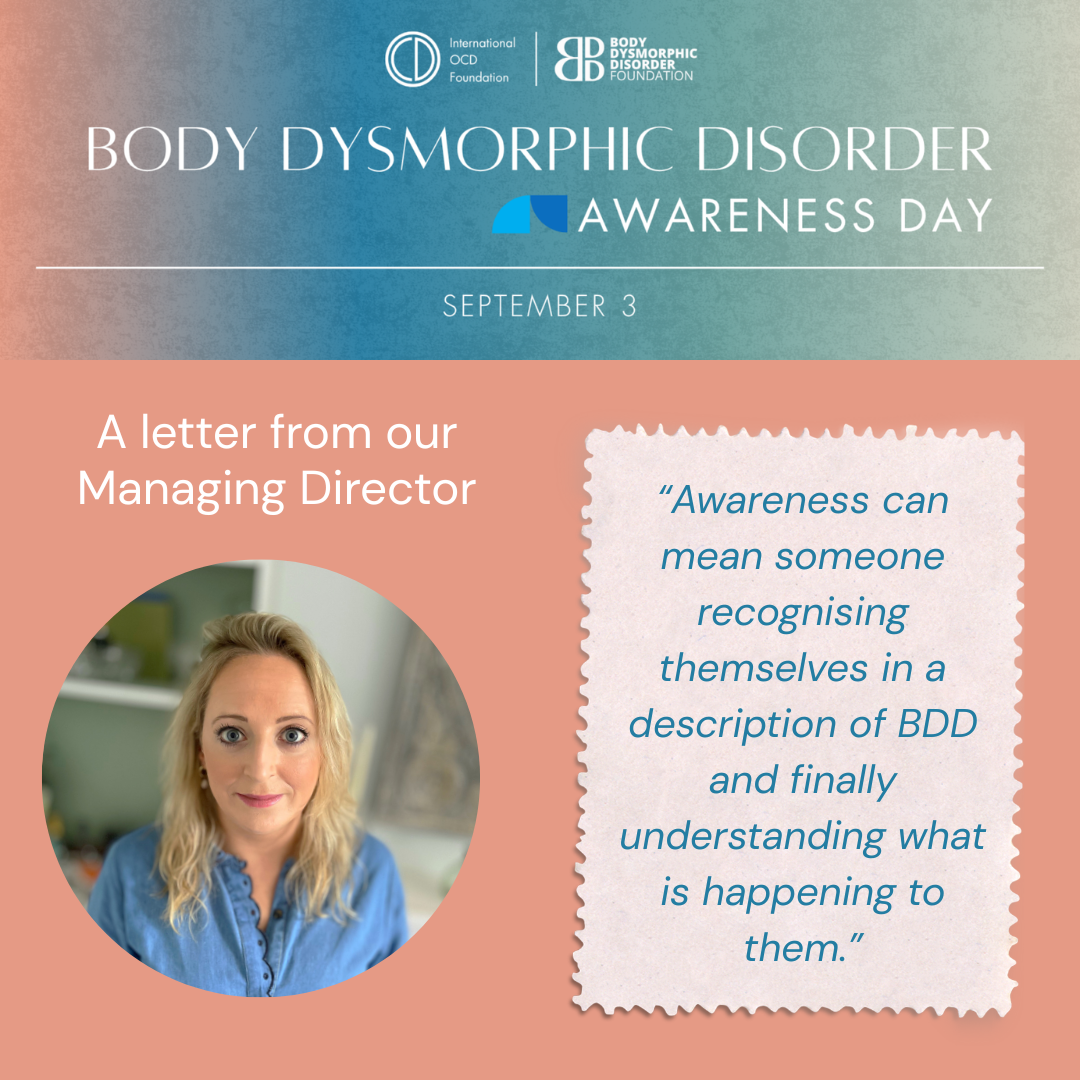
🔵 Awareness can mean someone recognising themselves in a description of BDD and finally understanding what is happening to them.
🔵 It can mean a parent recognising the signs in their child.
🔵 It can mean a GP or mental health professional asking a different question.
🔵 It can mean someone discovering that effective treatment exists.
🔵 And, ultimately, awareness can save lives.
I am living proof of what can happen when BDD is recognised and the right support becomes available. So are so many of our staff, volunteers and wider community.
That is why this first BDD Awareness Day matters so much to me, and why I hope it will be the beginning of something much bigger.
On 3rd September, the Body Dysmorphic Disorder Foundation, together with the International OCD Foundation, will launch the inaugural BDD Awareness Day. We want to make sure that more people know what BDD is, understand that it is a serious and treatable mental health condition, and know where to turn for support.
I hope you will help us spread the word.
Please share our BDD Awareness Day posts, talk about BDD with the people around you, share our resources, and help us reach the people who may need to see this message.
With heartfelt thanks,
Kitty Newman
Managing Director & Lived Experience Advocate