
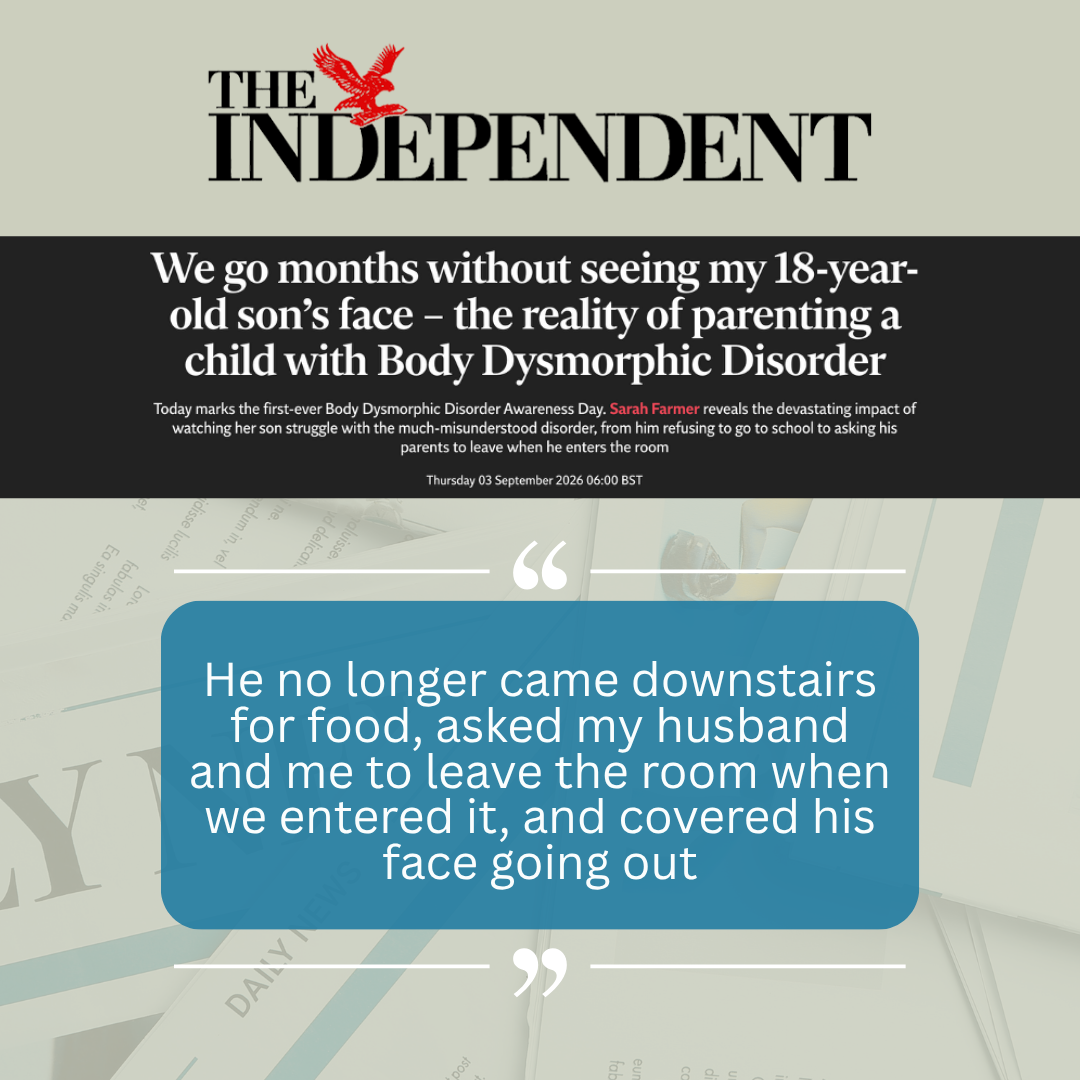
The Independent has marked the first ever BDD Awareness Day with a powerful account from a mother, Sarah, whose teenage son is living with severe BDD.
Published on 3 September 2026, the article offers a deeply personal insight into the reality of living alongside BDD and the profound impact the condition can have on individuals and their families.
Sarah describes how her son, who had previously been a happy, sociable child, began experiencing difficulties following the return to school after lockdown. Bullying, increasing self-consciousness about his appearance and concerns about his skin and facial features gradually became more severe.
Over time, his BDD led him to withdraw almost completely from everyday life. He began covering his face, avoiding going out and spending much of his time alone in his bedroom. At times, even communicating with his family became extremely difficult.
The article highlights an important distinction between BDD and ordinary concerns about appearance. For someone with BDD, worries about perceived flaws can become overwhelming and profoundly distressing, affecting education, relationships, social activities and everyday life.
The impact on families
One of the most important aspects of the article is the insight it gives into the experience of family members. Sarah describes the heartbreak of wanting to reassure her son that he is loved and valued, while knowing that his BDD makes it extremely difficult for him to believe those reassurances. She also describes the isolation that can come with supporting someone with a poorly understood mental health condition.
The effects have extended across the whole family. School and social activities have been disrupted, family celebrations have become difficult, and relatives have struggled with the emotional impact of seeing someone they love become increasingly isolated.
Sarah also speaks honestly about the difficulty of finding appropriate support. It took almost two and a half years from the first signs that something was wrong to receiving a BDD diagnosis and accessing specialist treatment, alongside significant financial costs from counselling.
The importance of specialist understanding
The experience described in the article also demonstrates why greater awareness and understanding of BDD are so important. Sarah and her family initially encountered professionals who did not have specialist expertise in BDD. Sarah shares how some advice appeared to reinforce her son’s avoidance and made his difficulties worse.
Eventually, they found professionals with specific knowledge of BDD, leading to a diagnosis and a clearer understanding of the treatment and support he needed.
His planned specialist treatment includes cognitive behavioural therapy (CBT) and exposure-based work, approaches intended to help him challenge the negative beliefs and fears associated with his BDD and gradually face situations that have become difficult.
Improving awareness of BDD
This story is ultimately one of both the devastating impact of BDD and the importance of hope.
Thank you to Sarah for sharing how difficult it can be when other people misunderstand the condition as vanity, laziness or simply not wanting to go to school. As the article makes clear, severe BDD can be profoundly debilitating, and the person experiencing it is not choosing to live this way.
By sharing her family’s experience, Sarah hopes that greater openness around BDD will help bring the condition into the mainstream conversation and encourage greater understanding and compassion.
At the BDD Foundation, we know that awareness matters. Understanding BDD can help people recognise the signs, challenge misconceptions and seek appropriate support.
The article can be accessed here if you have an account